
The Polar Ring: Why Trump Wants Greenland (and More)
When Donald Trump announced on January 21st that he had reached "the framework of a future deal" with NATO over Greenland, relieved sighs echoed through Copenhagen. Hours earlier, America's president had finally ruled out military force to seize the Danish territory, a threat that had escalated dangerously through early January, complete with tariff ultimatums against eight NATO allies. Yet the abrupt pivot from invasion threats to vague frameworks, combined with simultaneous musings about annexing Canada and reclaiming the Panama Canal, suggests something more ambitious than securing a single Arctic base. What if Greenland is not the objective but rather one piece in a larger bid for hemispheric dominance?
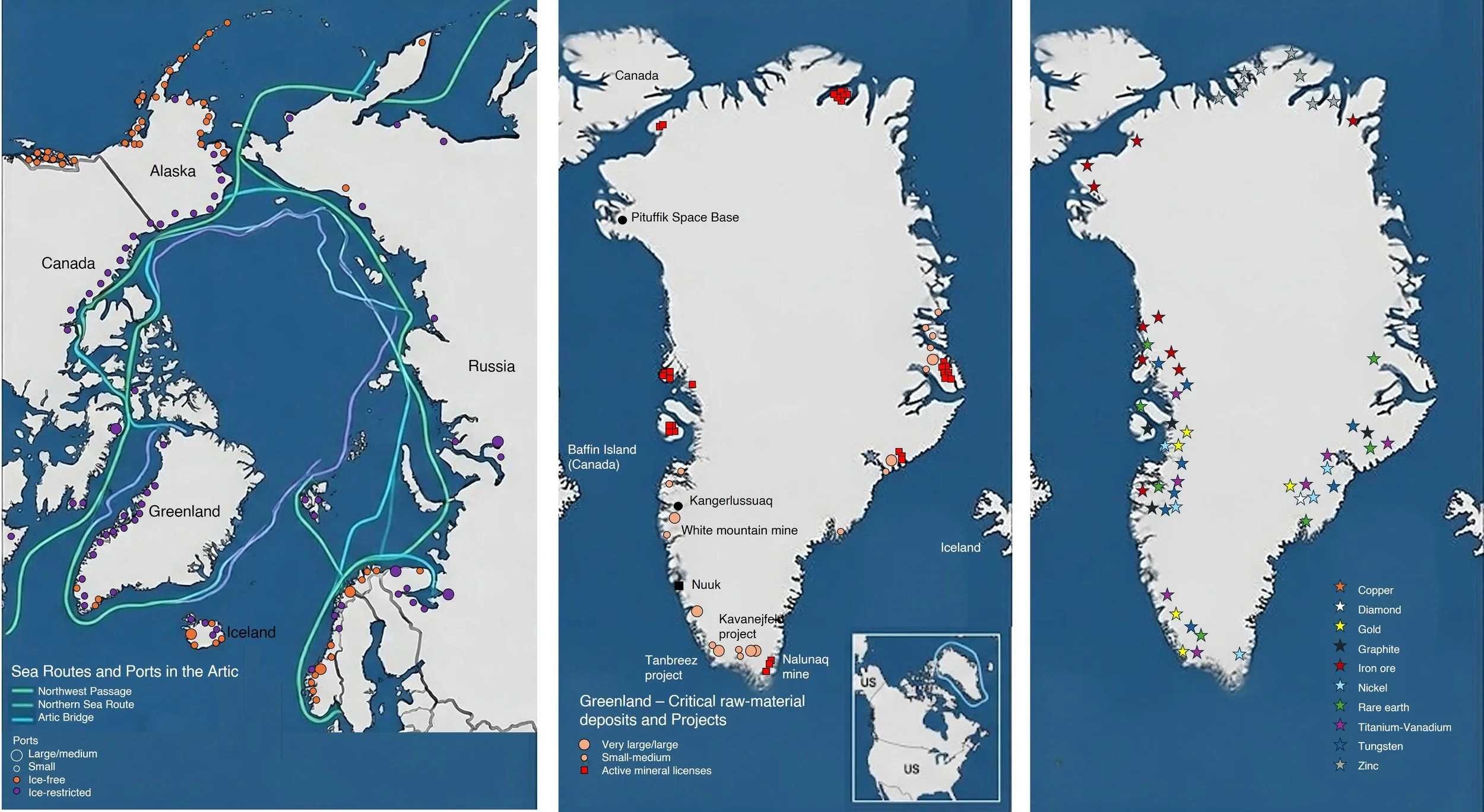
The official explanations—national security and rare-earth minerals—crumble under scrutiny. Start with the defence rationale. Greenland does matter strategically: the Pituffik Space Base tracks ballistic missiles; the GIUK gap (between Greenland, Iceland and Britain) remains a critical chokepoint for monitoring Russian submarines; and retreating Arctic ice opens new shipping routes that could reduce Asia-Europe transit times by 40%. Classical geopolitical theorists from Mahan to Brzezinski would recognise Greenland as a geographic pivot whose alignment shapes great-power competition.
But America already has what it needs. The 1951 U.S.-Denmark Defence Agreement grants Washington extensive rights to expand its military presence in Greenland at will. During the Cold War, America operated 13 bases there; it consolidated to one but faces no legal barrier to re-establishing forward positions. Denmark welcomes expanded American presence and just announced plans to spend DKK 27.4bn (USD 4.3bn) on Arctic ships, patrol aircraft and radar systems, plus another DKK 29bn for F-35 jets. Russian activity near Greenland remains minimal—Moscow's ambassador has explicitly disavowed territorial ambitions—and Chinese warships haven't visited in over a decade. As one American official inadvertently admitted: "We need to secure it against future threats." The threat, in other words, is anticipatory rather than imminent.
The economic case fares even worse. Yes, Greenland possesses substantial resources: 36.1million tonnes of rare-earth elements, significant uranium and gold deposits, and potentially 31.4 billion barrels of oil equivalent offshore. China supplies over 90% of global rare-earth production and imposed export controls on heavy rare earths in 2025, disrupting Western supply chains. But mining in the Arctic costs two to three times more than equivalent projects at lower latitudes. Greenland has virtually no infrastructure: fewer than 100 miles of paved roads exist across an island four times the size of France. Temperatures of -40°C make metal brittle. The flagship Tanbreez rare-earth mine will have spent USD 290m before operations begin in 2027, if they begin at all. The Mary River iron-ore mine in Canada's Nunavut territory—far simpler to operate than rare-earth mines—reportedly lost USD 310m between 2016 and 2019.
American officials estimate that building and maintaining five bases in Greenland would cost USD 20bn-30bn over a decade. Developing commercially viable rare-earth operations would cost hundreds of billions more. For comparison, America could subsidise every non-Chinese rare-earth project globally for a fraction of what Greenland acquisition would cost.
So if neither defence nor resources justify the costs, what explains Mr. Trump's fixation? One provocative answer points that Greenland is about controlling one side of the "polar ring" to counter Russia, box in Canada, and negotiate the Northern Sea Route on equal terms with Moscow.
The arithmetic is straightforward. Russia controls roughly 50% of the Arctic coastline—some 24,000-35,000 km of northern shore—while Norway holds approximately 5%. By combining Alaska with Greenland, America would control roughly 45% of the Arctic perimeter. This would transform Washington from supplicant to peer in negotiations over the Northern Sea Route, which offers 40% cost savings on Rotterdam-Shanghai voyages compared with Suez and could become a major commercial artery as polar ice retreats.
Currently, Russia dominates Arctic infrastructure with 40 icebreakers, including nuclear-powered vessels, compared with America's single heavy icebreaker. Moscow has refurbished or established 30 military installations along its Arctic coastline and integrated the Northern Sea Route into China's Belt and Road Initiative. Chinese access to Europe via the Arctic reduces the strategic relevance of Suez and American control of chokepoints like the Strait of Malacca. Washington compensates for this shift only by gaining physical control of western Arctic space, hence Greenland.
But the Greenland gambit unlocks a second strategic dividend: the encirclement of Canada. With America to the south, Alaska to the west, and Greenland to the east, Canada becomes "the new Poland", geographically boxed in, with 80% of its population concentrated within 80 km of the American border. This configuration, combined with Canada's modest military capabilities, renders it "non-resistant" should Washington decide to force a change in status.
Mr. Trump has already mused publicly about Canada becoming America's 51st state, dismissed Prime Minister Justin Trudeau as "Governor Trudeau," and suggested Canadians would benefit from American governance. Viewed in isolation, these seem like trademark Trumpian provocations. Viewed alongside Greenland and Panama Canal references, they sketch a hemispheric consolidation strategy: control of North American territory from the Arctic to Central America, with strategic Atlantic anchor points (Greenland, Iceland, Azores, Falklands) securing sea lanes.
This is neither Mahan's maritime strategy (control of trade routes through naval supremacy and bases acquired through alliance), nor Spykman's Rimland containment (forward positioning along Eurasia's periphery to prevent any single power from dominating the World-Island). It more closely resembles Haushofer's Lebensraum concept, but in its most aggressive iteration: not the "friendship-based living space" Haushofer advocated but the Hitler-era version that reduced neighbours to subjugation.
The strategic logic becomes clearer when viewed from Beijing and Moscow. China's Belt and Road Initiative has systematically reduced dependency on American-controlled maritime chokepoints by developing overland corridors through Central Asia and, increasingly, Arctic sea routes. Russia provides the northern corridor that China lacks organically—both nations benefit from integrating the Northern Sea Route into Eurasian trade networks that bypass American naval dominance.
From this perspective, Greenland represents Washington's attempt to insert itself into an Arctic increasingly dominated by Sino-Russian cooperation. But the asymmetry in capabilities—Russia's icebreaker fleet, its Arctic coastline, its alliance with China—suggests that "Orient controls the Arctic, not Occident." America arrives late to a game where infrastructure, geography and cooperation favour its rivals.
The irony is profound. Classical geostrategy teaches that certain positions grant enduring advantage—that geography is destiny. Mackinder's Heartland theory posited that control of the Eurasian interior determined global dominance; Mahan argued that naval supremacy separated great powers from regional ones. Mr. Trump's Arctic ambitions reflect both impulses: establishing territorial control (à la Mackinder) to project maritime power (à la Mahan). But the theorists also understood that geography interacts with politics, economics and alliances. Threatening NATO members to acquire territory they already permit you to use militarily undermines the coalition politics that enable power projection.
Consider the self-inflicted damage. Denmark, which lost soldiers in Afghanistan supporting American operations, now faces threats from the ally it bled for. A Danish intelligence report mentioned America as a potential national security threat for the first time in history. Canada, America's largest trading partner and fellow Five Eyes member, confronts annexation rhetoric from Washington. European publics question American reliability. Russia gleefully compares Greenland to Crimea. And Greenlanders—85% of whom reject American ownership—feel coerced rather than courted.
Meanwhile, China and Russia draw precisely the lesson Mr. Trump presumably hopes to deter: that Washington prioritises unilateral power over alliance cohesion, that its security guarantees are transactional, and that it will coerce partners when expedient. This hardly discourages them from deepening Arctic cooperation or pursuing alternative trade corridors. If anything, American threats against Denmark vindicate their strategy of reducing dependency on U.S.-dominated systems.
Perhaps the charitable interpretation is that Mr. Trump's Greenland fixation serves primarily domestic political purposes, demonstrating boldness to his base, dominating news cycles, positioning himself as a leader who thinks big. The international dimension becomes theatre: threaten allies, step back to negotiate, declare victory regardless of outcome. If Denmark grants expanded base rights or mineral-development partnerships, he secured concessions through toughness. If negotiations collapse, he exposed European weakness. Either way, he proves that alliance commitments are transactional.
But this reading understates the strategic coherence. The simultaneous targeting of Greenland, Canada and Panama, combined with the Arctic arithmetic, suggests a genuine bid for hemispheric consolidation. Whether this represents calculated grand strategy or instinctive territorialism matters less than its implications: America's post-war alliance system, built on credible security guarantees and mutual defence, gives way to something more transactional and coercive.
The tragedy is that genuine strategic imperatives exist. Arctic shipping routes will open. China is developing alternatives to American-controlled chokepoints. Rare-earth supply chains do require diversification. Addressing these challenges requires precisely what Mr. Trump's approach undermines: alliance cohesion, burden-sharing with partners, and credible security guarantees that encourage friends to host American forces rather than seeking strategic autonomy.
The "framework" announced in Davos may yet produce face-saving compromise: perhaps expanded base rights, joint mineral-development ventures, enhanced NATO Arctic cooperation, and American investment in Greenlandic infrastructure. Mr. Trump can declare victory, Denmark preserves sovereignty, Greenlanders avoid colonial status, and the alliance survives.
But even if the immediate crisis resolves, the pattern persists. Allies from Copenhagen to Ottawa learn that proximity to America carries risks as well as benefits, that Washington's guarantee depends less on shared values than presidential calculation. Rivals from Beijing to Moscow learn that American commitments are conditional, that alliances can be threatened for advantage, and that their strategy of developing alternative corridors was prescient.
Greenland is strategically significant. The Arctic will matter more as ice retreats. But America already had the access it needed, through alliance, treaty rights, and Danish cooperation. The crisis, manufactured for domestic consumption or genuine hemispheric ambition, may cost more than any rare-earth mine or Arctic base could ever be worth. Classical geostrategists understood that control of pivotal territories matters. They also understood that maritime powers prosper through alliance networks, not territorial conquest. The frozen island may be worth a base. It is emphatically not worth an alliance, or a hemisphere. ■