
Wings of Change: How Airbus is winning the battle for the skies
When Margaret Thatcher dismissed Europe's ambition to build an American-beating single-aisle jet in the 1980s, she spoke for an entire generation of sceptics. Britain, however, contributed nearly GBP 250m toward the programme anyway. That investment has proved among the shrewdest in industrial history. The A320 family is now poised to overtake Boeing's 737 as the most delivered commercial aircraft franchise ever, with more than 12,000 delivered since launch.
What once looked like a stable equilibrium—two giants roughly matched, airlines playing one off against the other—now resembles something else: a system under strain, in which one champion has accrued structural advantage whilst the other struggles to prove it can still make aeroplanes at scale, on time and to standard.
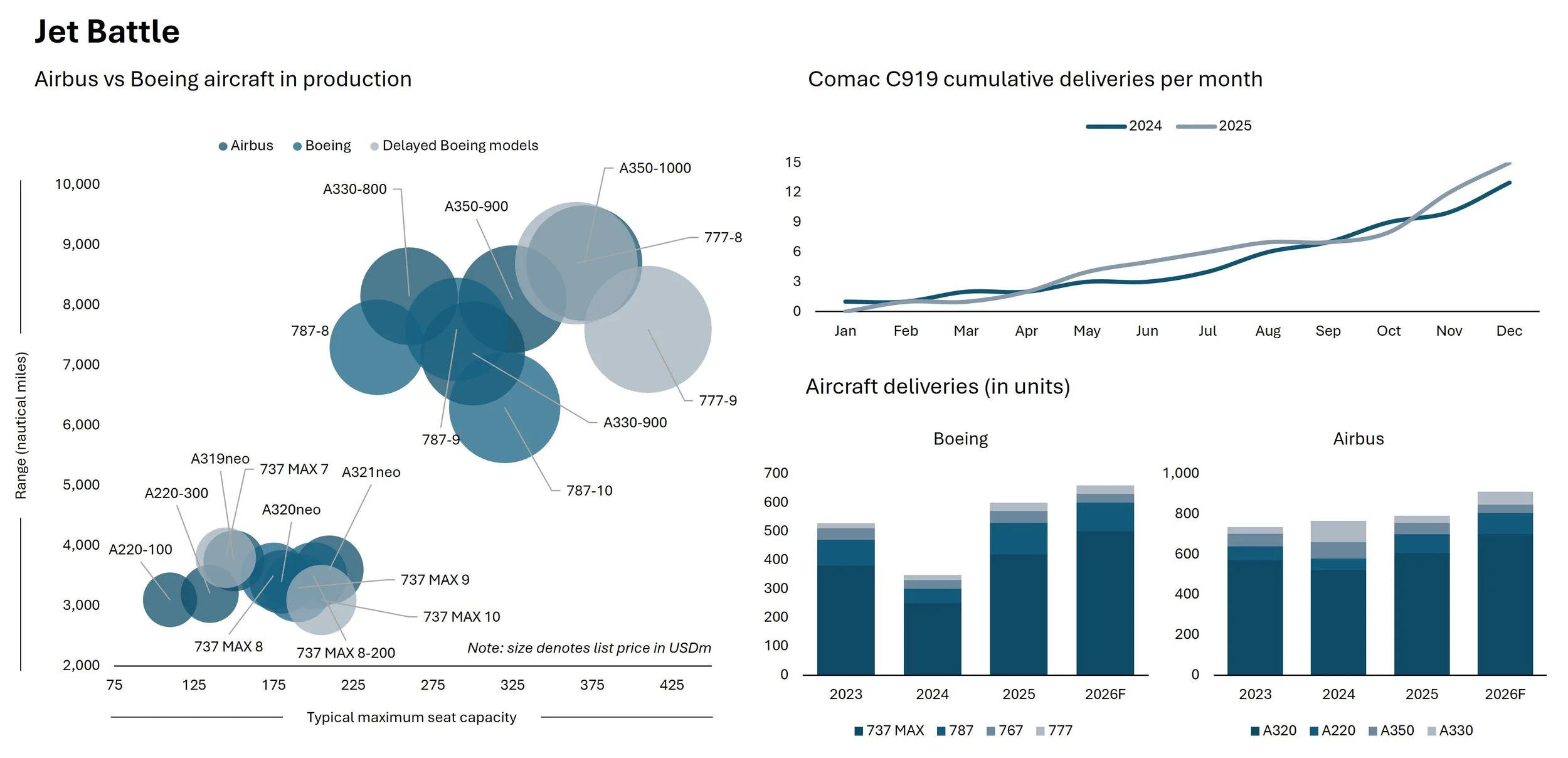
The industry's surface signals can mislead. Boeing led in gross orders in 2025 for the first time this decade (1,075 versus Airbus's 1,000). But the deeper scoreboard tells a harsher story. Airbus delivered 793 jets in 2025 to Boeing's 600, and ended the year with a backlog of 8,754 aircraft versus Boeing's 6,130. Airbus made EUR 5.4bn in operating profit; Boeing posted a USD10.7bn operating loss. Those are not the metrics of a temporary wobble. They are the contours of an industrial divergence.
Airbus's ascendancy has been anything but fortuitous. The turning point came in 2017, when Boeing tried to kill Bombardier's CSeries by lobbying for punitive tariffs. Boeing's assault achieved precisely what it sought to prevent: Airbus acquired 50.1% of the programme for a single dollar. The rebranded A220 now fills the 100-150 seat segment Boeing vacated, with over 900 orders. Boeing tried to kill the CSeries and ended up gifting Airbus the A220; then it tried to buy Embraer to plug the gap and got nothing: two chances at a small-jet strategy, both blown.
Consider next the A321XLR, delivered from late 2024. Its proposition is quietly radical: narrow-body economics with wide-body range—up to 11-hour flights—opening routes that previously required larger, costlier aircraft. The XLR exploits a gap Boeing created when it discontinued the 757 in 2004. Even Qantas, historically an all-Boeing narrow-body customer, ordered XLRs—a defection that matters as much symbolically as commercially. Boeing's nearest answer, the 737 MAX 10, remains delayed awaiting FAA certification, potentially into 2027.
Airbus has also proved willing to play hardball. In the Qatar Airways dispute over A350 paint degradation, Airbus invoked cross-default provisions to cancel 50 A321neo orders, using the scarcity of narrow-body delivery slots as a cudgel. The case settled on Airbus's terms. The lesson is clear: today Airbus can afford to walk away. Boeing cannot.
Boeing's crisis stems from compounding failures. Two 737 MAX crashes killed 346 people and triggered a 20-month grounding. Then came the January 2024 Alaska Airlines door-plug blowout, exposing persistent manufacturing failures. Regulators responded with hard production caps that constrain cash generation and strategic freedom.
Strategic missteps compounded the damage. In 2005 Boeing spun off major manufacturing into Spirit AeroSystems as part of an "asset-light" model. In December 2024 it agreed to reacquire Spirit's Boeing operations, quadrupling the price whilst inheriting deep quality-control problems. The third wound is financial paralysis. Boeing's commercial division has been haemorrhaging cash; its defence business has posted losses for three consecutive years. The company needs to restore cash generation before funding a new aircraft. Yet the longer it delays a clean-sheet successor, the more Airbus's lead hardens. This is innovation paralysis: the future held hostage by the present.
If this were merely a corporate contest, Boeing's route back would be straightforward. But the duopoly now sits inside geopolitics. In 2025, aircraft orders behaved like diplomatic currency. Qatar ordered up to 210 Boeing wide-bodies during President Trump's visit; Japan agreed to buy 100 Boeing aircraft as part of a trade deal; Korean Air placed a record order hours after its president met Trump. Christian Scherer, Airbus's outgoing commercial chief, captured the dynamic: Boeing's wins were undeniably assisted by "political backing." But if customers buy Boeing to please the White House rather than because the product is best, it is clear what the veredict of the market is.
Trade policy has become a competitive instrument. Baseline 10% tariffs and levies threaten the industry. Ironically, this environment can favour Airbus, which has final-assembly in Mobile, Alabama. Boeing's export dependence is heavier—around 80% versus roughly 50% for Airbus—making retaliation more painful.
Geopolitics also reshapes China, the biggest growth market. Airbus's in-service fleet now accounts for more than half the market. In late December 2025, Airbus signed deals for more than 140 A320-family jets from Chinese airlines, cementing its near-monopoly as Boeing is politically excluded.
Every duopoly story demands a would-be disruptor. China's Comac fills that role. The C919 has around 1,000 orders and 17 aircraft in service, but it's best seen as a strategically important spoiler, not an imminent equal. It relies heavily on foreign components—the engine is the LEAP-1C from CFM, with the core module produced in Ohio. Without FAA or EASA approval, the C919 cannot operate in most international airspace. Comac can carve out China's domestic demand—potentially 30-40% by the early 2030s—but as a global competitor, it remains years away.
However, the demise of the Sukhoi Superjet 100 and Irkut MC-21 show how fast an airliner programme dies when supply chains, certification and support are cut off. Russia built just seven commercial aircraft in 2022–24—about two days of Airbus output—because modern aviation runs on trust as much as tooling.
Herein lies the paradox: Boeing's political protection may inadvertently accelerate the competitive threats it seeks to forestall. Washington's intervention signals to other nations that dependence on American aerospace is a strategic vulnerability. China's determination to make Comac viable reflects precisely this calculation. Each politically motivated Boeing sale reinforces that logic. Airlines in neutral nations increasingly view Boeing as carrying geopolitical risk, whilst Airbus benefits from European neutrality.
The irony is profound: American political backing may save Boeing from market defeat in the 2020s, but at the cost of ensuring a more fragmented, less American-dominated industry in the 2030s. Every government-brokered Boeing deal validates the case for indigenous aerospace programmes.
The Airbus-Boeing contest is no longer about discounts at air shows. It is about who can convert backlog into deliveries under constrained supply chains, and who can credibly fund the next platform whilst cleaning up the last one. Airbus must avoid complacency and execute its ramp to 75 monthly aircraft by 2027. Boeing must stabilise quality, satisfy regulators, integrate Spirit and restore cash generation, all whilst its product gaps widen.
The duopoly will endure because its barriers remain formidable. But its character has changed. Airbus is no longer merely "the other option"; it is, in many segments, the default. Boeing still has scale, an installed base and a political backstop. Yet until it can show years of flawless execution, it will remain what it has become: a national champion kept aloft not only by engineering, but by statecraft.
Boeing's crisis and Airbus's triumph mark not just a shift in competitive balance, but a transition to a new era: the age of the unchallenged duopoly is ending. For half a century, Airbus mastered the art of becoming boring, dependable, methodical, strategically patient; that discipline has brought it dominance. Boeing's task is to become boring again, before the industry's new entrants learn to be interesting. ■